Authors in Conversation
Enrollment Closed
A peer-reviewed biannual journal publishing research, critique, and creative expression at the intersection of classical traditions and contemporary thought.
Join our hybrid seminars where scholars, artists, and practitioners from across the globe gather to explore the living traditions of Indian heritage in contemporary and digital arts.
View All Events
Authors in Conversation
Enrollment Closed
Authors in Conversation
Enrollment Open
Authors in Conversation
Enrollment Open
Speaker
Monima Chadha is Professor of Indian Philosophy at the Faculty of Philosophy, University o…
Exploring Selfless Minds: A Contemporary Perspec…
Speaker
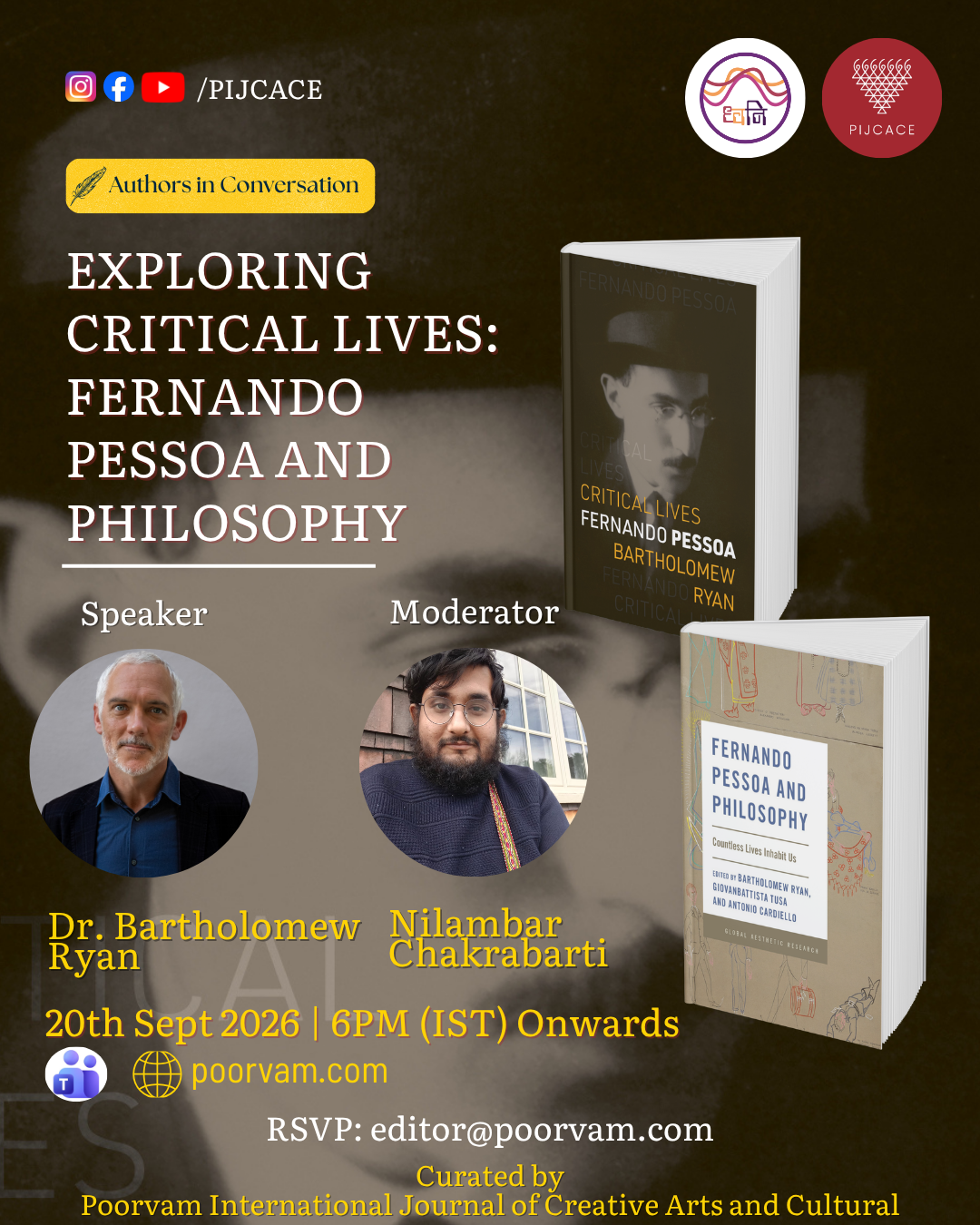
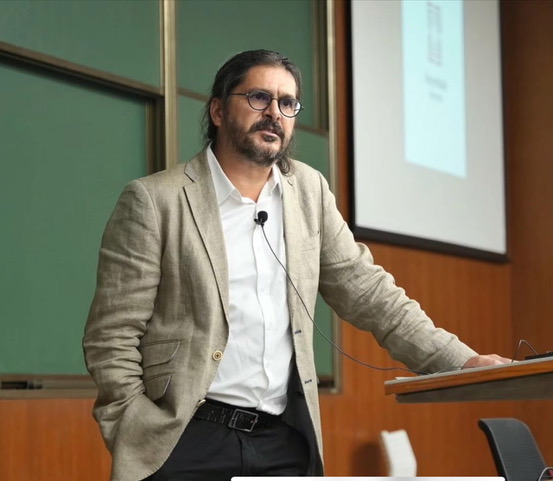
Bartholomew Ryan is a philosopher and musician, and holds a position as Research Professor…
EXPLORING CRITICAL LIVES: FERNANDO PESSOA AND PH…
Speaker
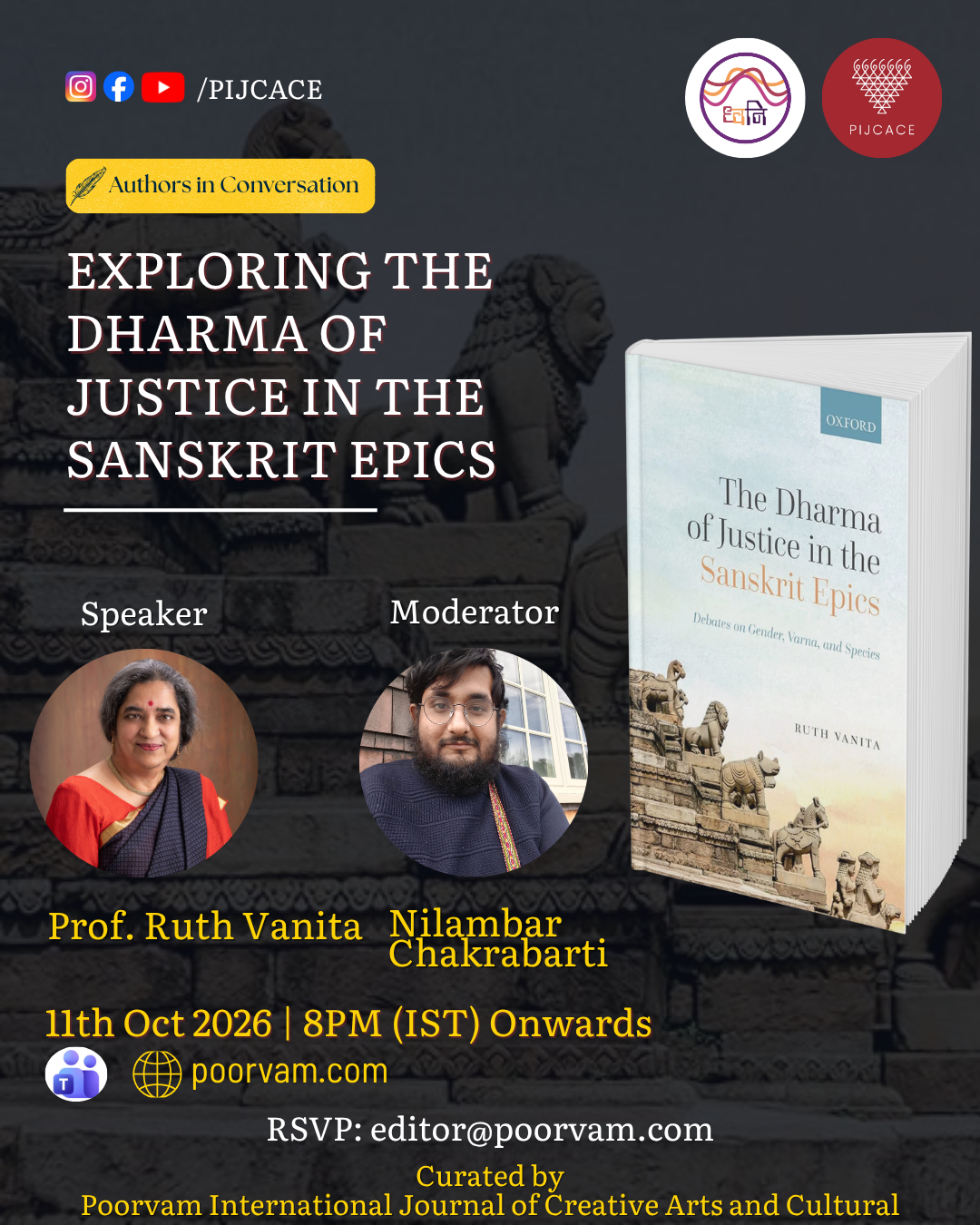
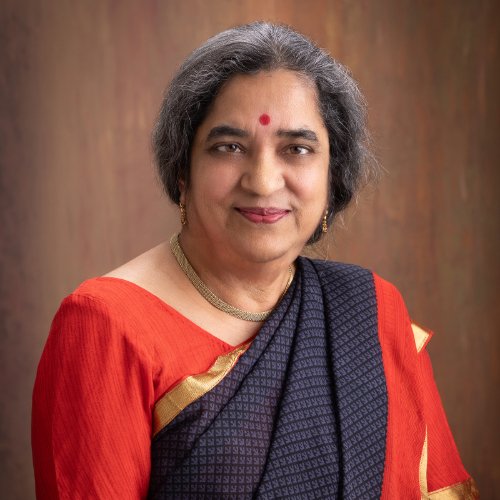
Ruth Vanita is a scholar, writer, and translator whose work spans Indian literary history,…
Exploring The Dharma of Justice in the Sanskrit …
Speaker
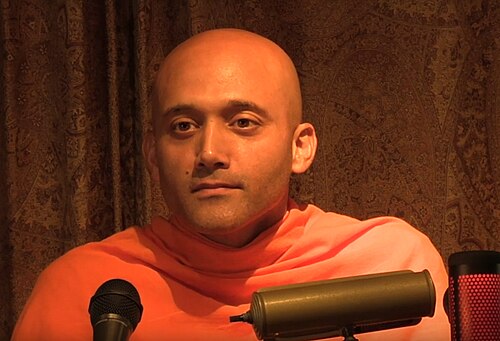
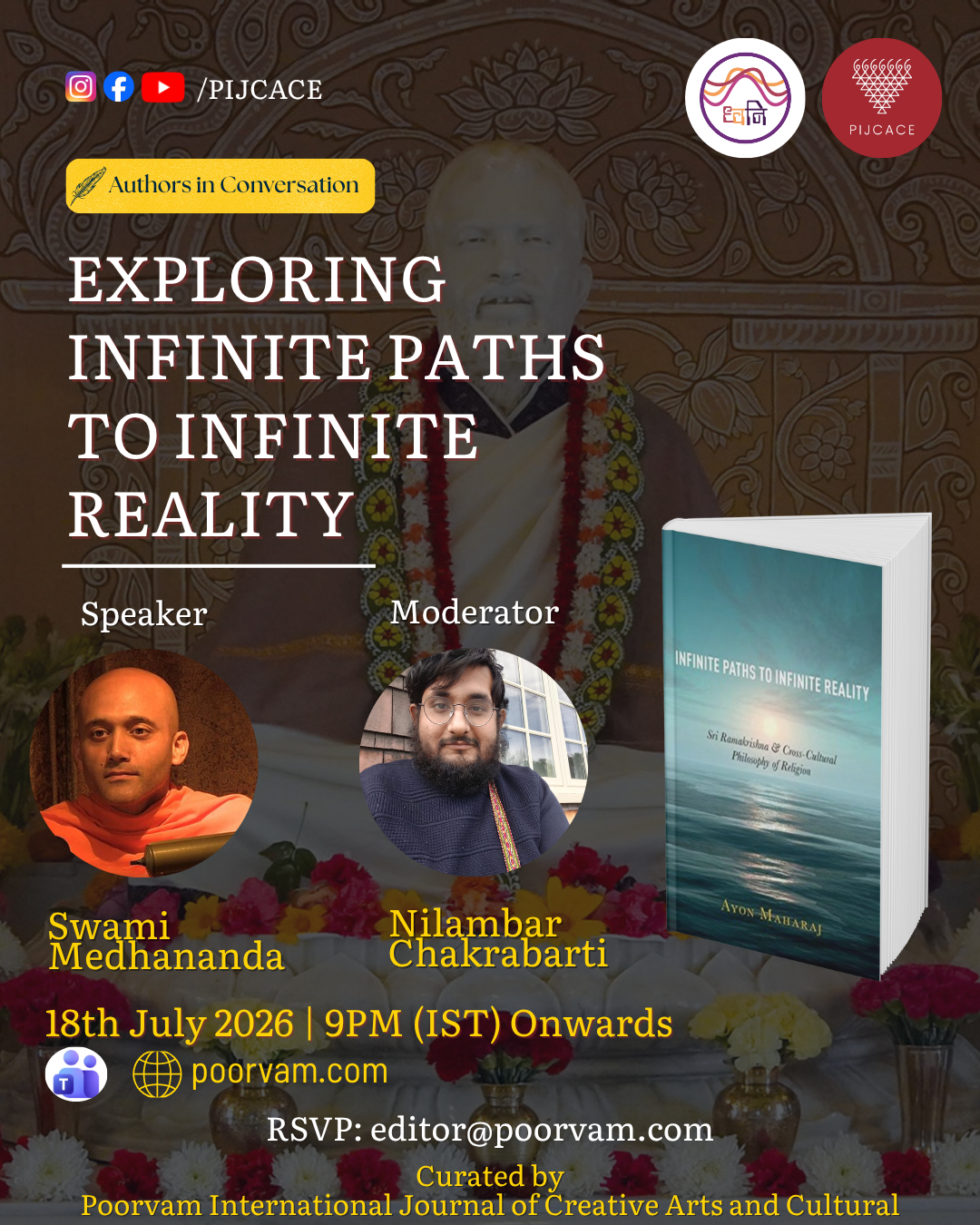
Swami Medhananda is a monk of the Ramakrishna Order and an academic philosopher, currently…
Exploring Infinite Paths to Infinite Reality…
Speaker
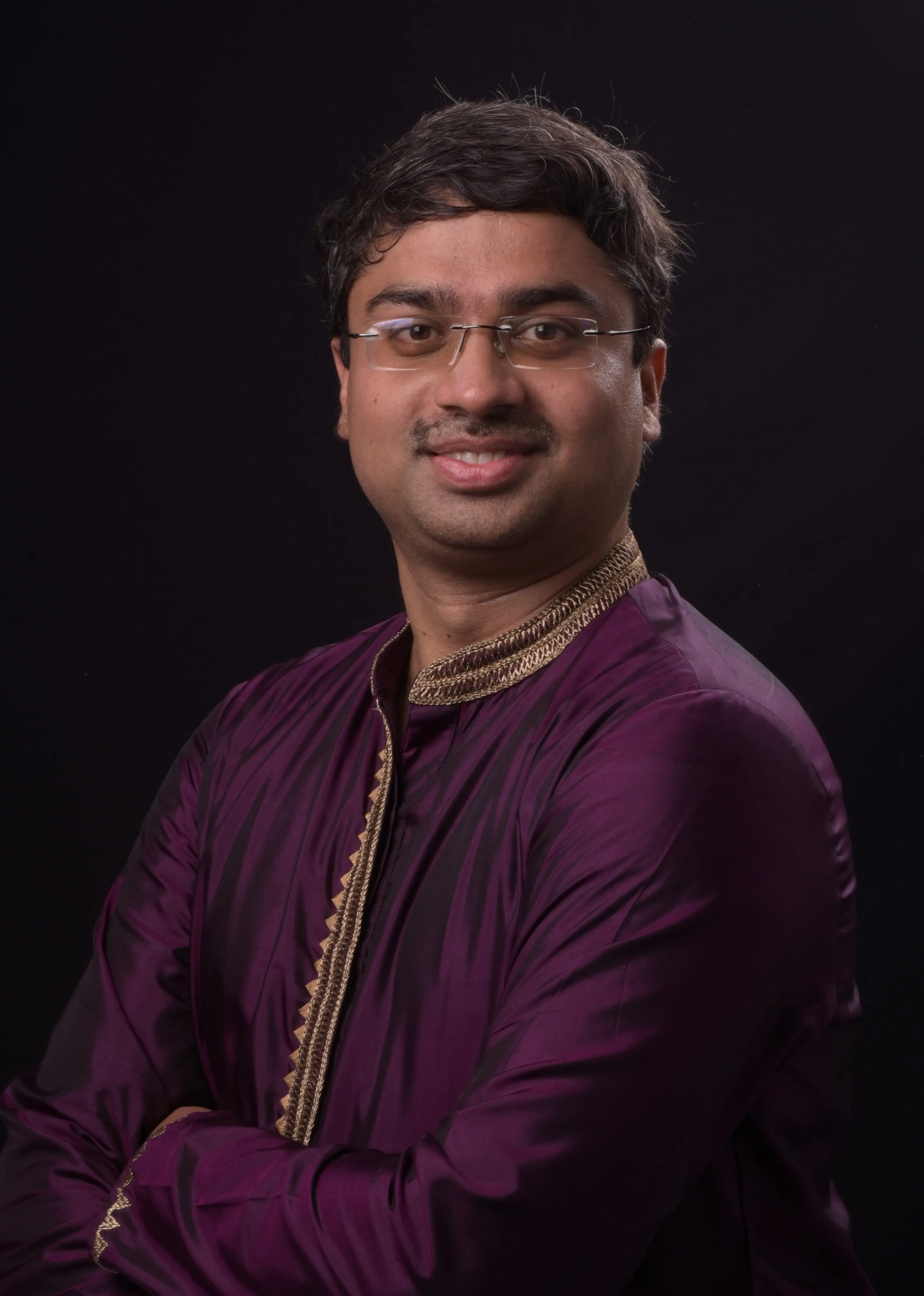
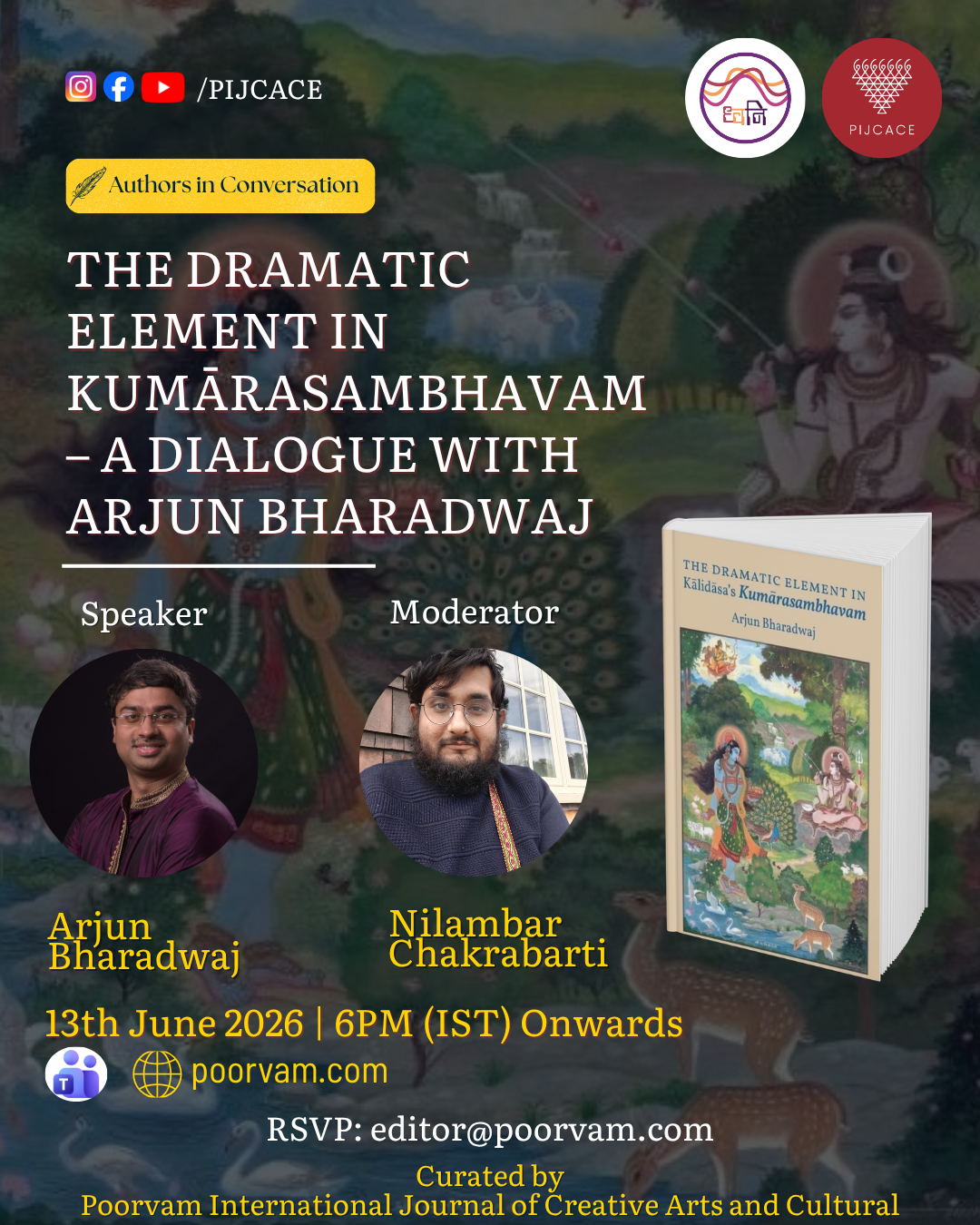
Arjun Bharadwaj is an author and researcher with a deep interest in classical literature, …
The Dramatic Element in Kumārasambhavam – A Dial…
Speaker
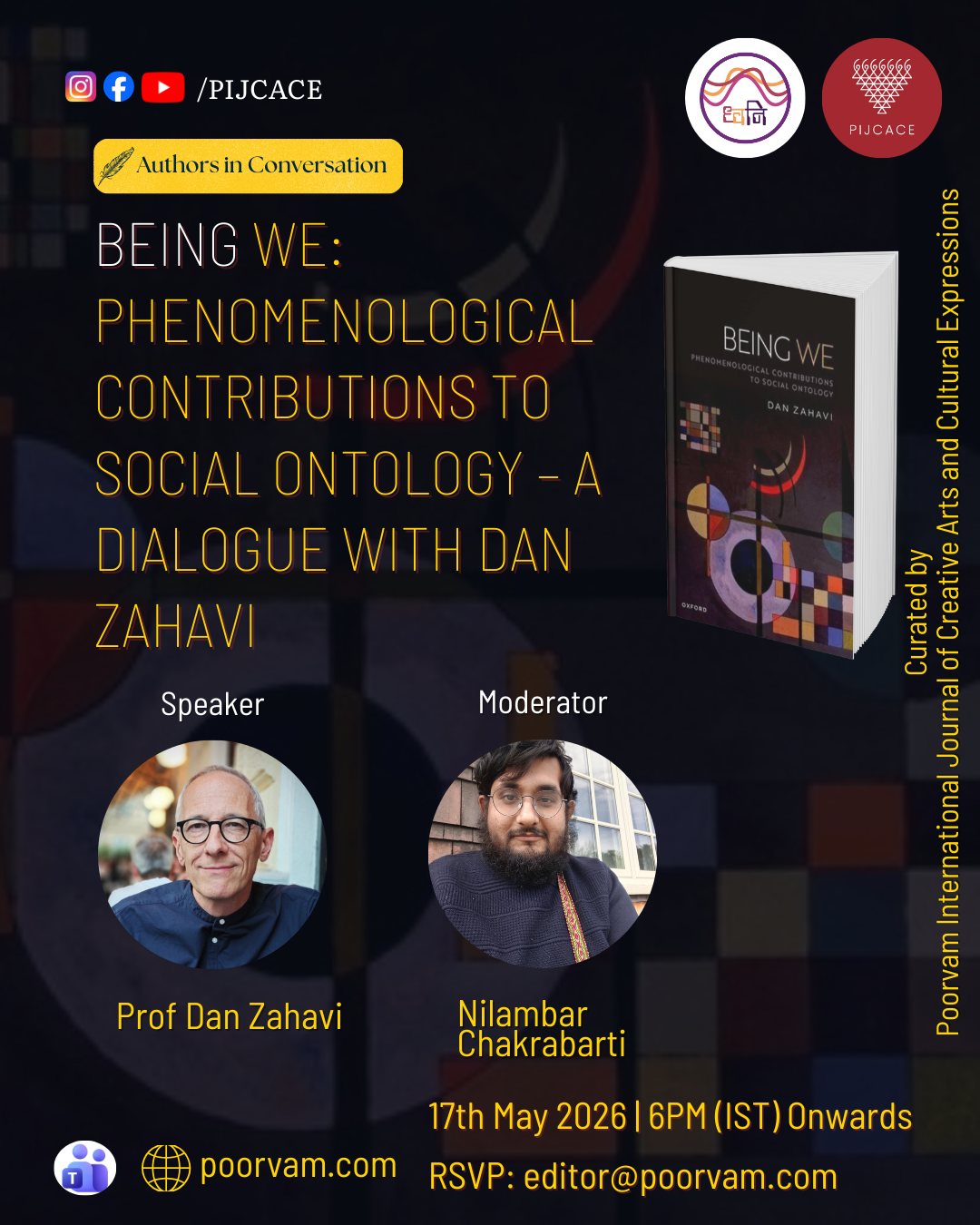
Dan Zahavi is a Professor of Philosophy and director of the Center for Subjectivity Resear…
Being We: Phenomenological Contributions to Soci…
Speaker
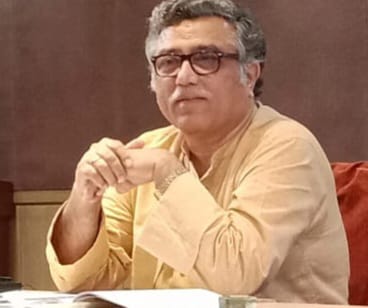
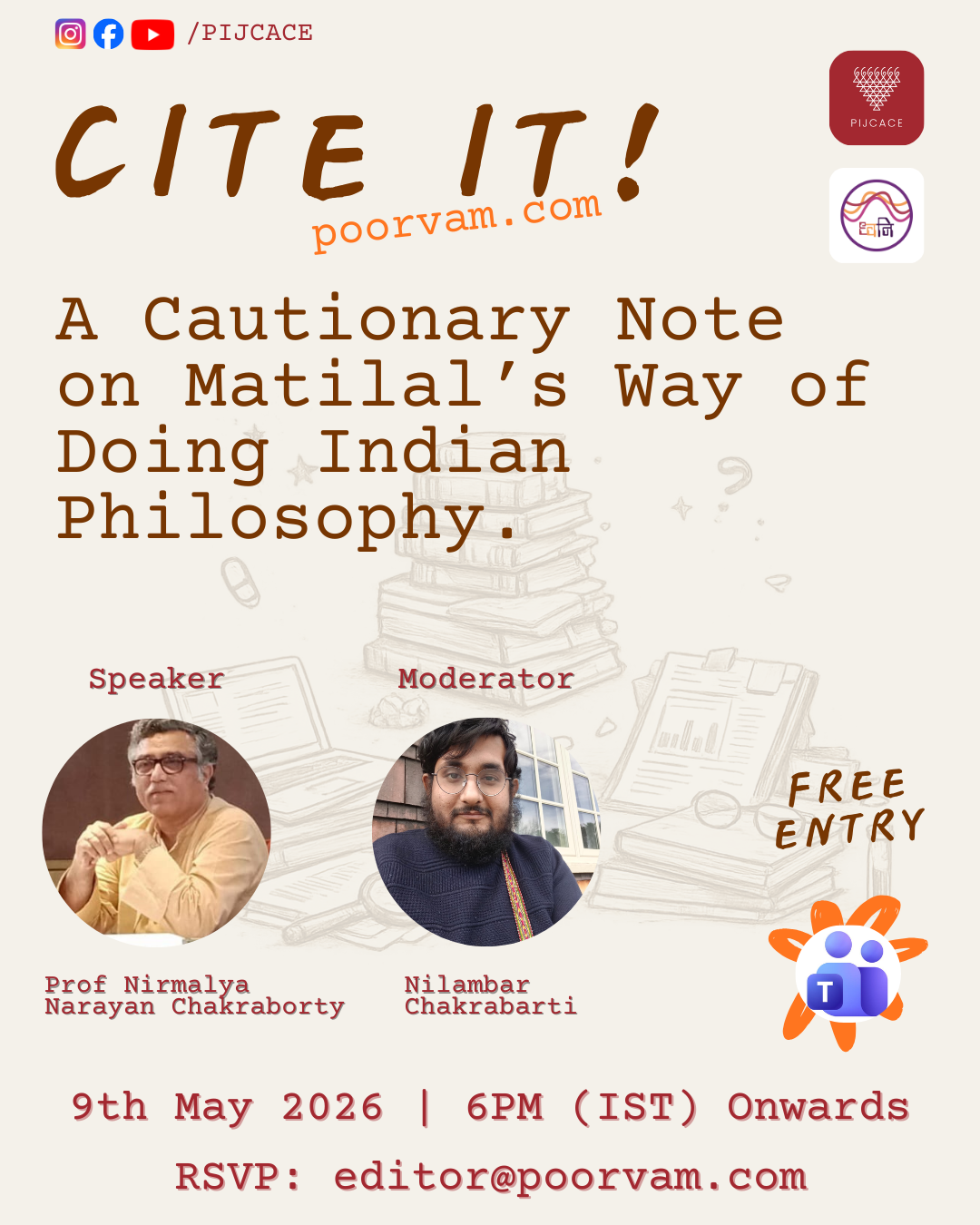
Nirmalya Narayan Chakraborty is presently Vice-Chancellor of Presidency University, Kolkat…
Cite It: A Cautionary Note on Matilal’s Way of D…
Speaker
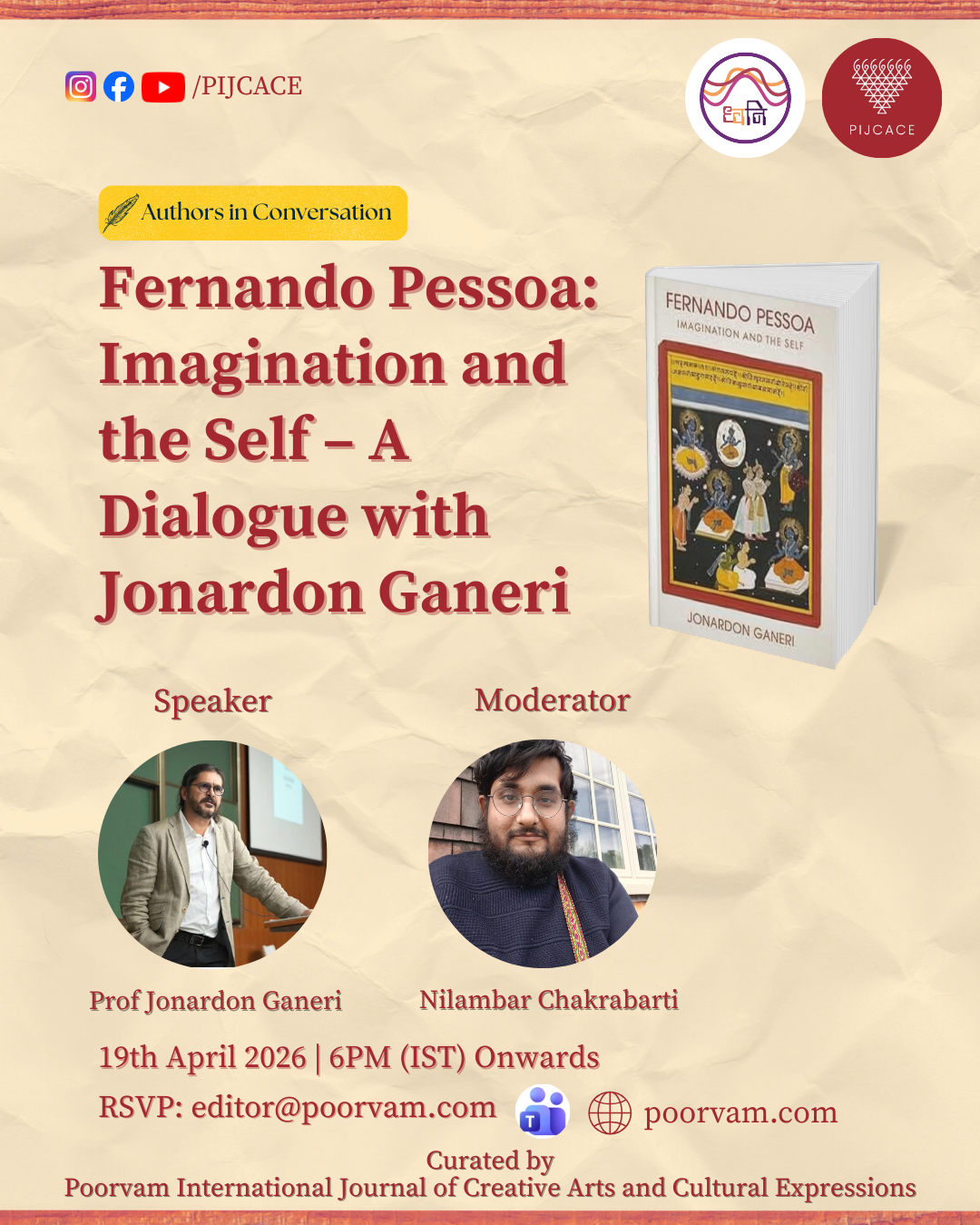
Jonardon Ganeri is the Bimal. K. Matilal Distinguished Professor of Philosophy at the Univ…
Fernando Pessoa: Imagination and the Self – A Di…
Speaker
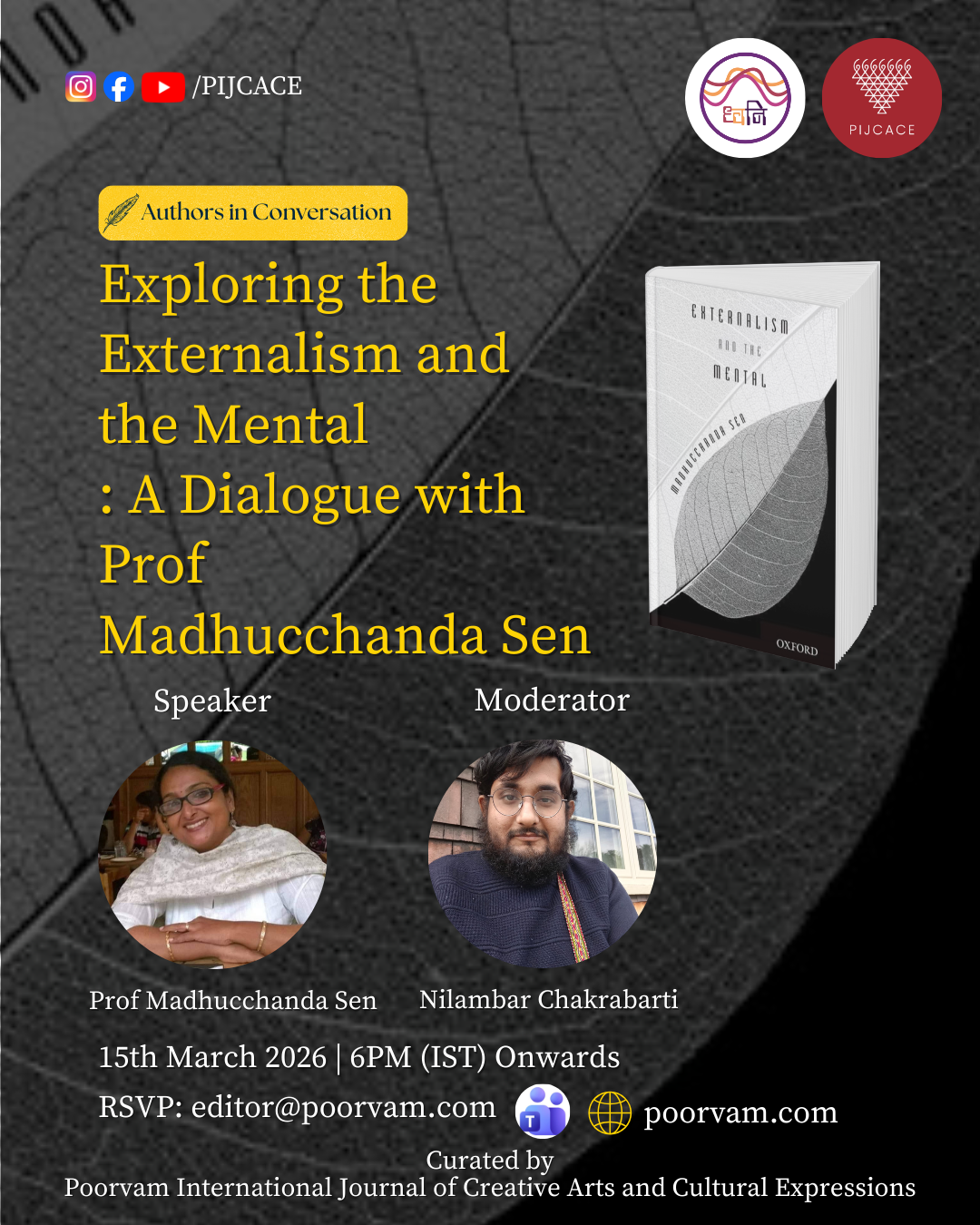
Prof. Madhucchanda Sen is a Professor of Philosophy at Jadavpur University, where she has …
Exploring the Externalism and the Mental : A Dia…
Speaker
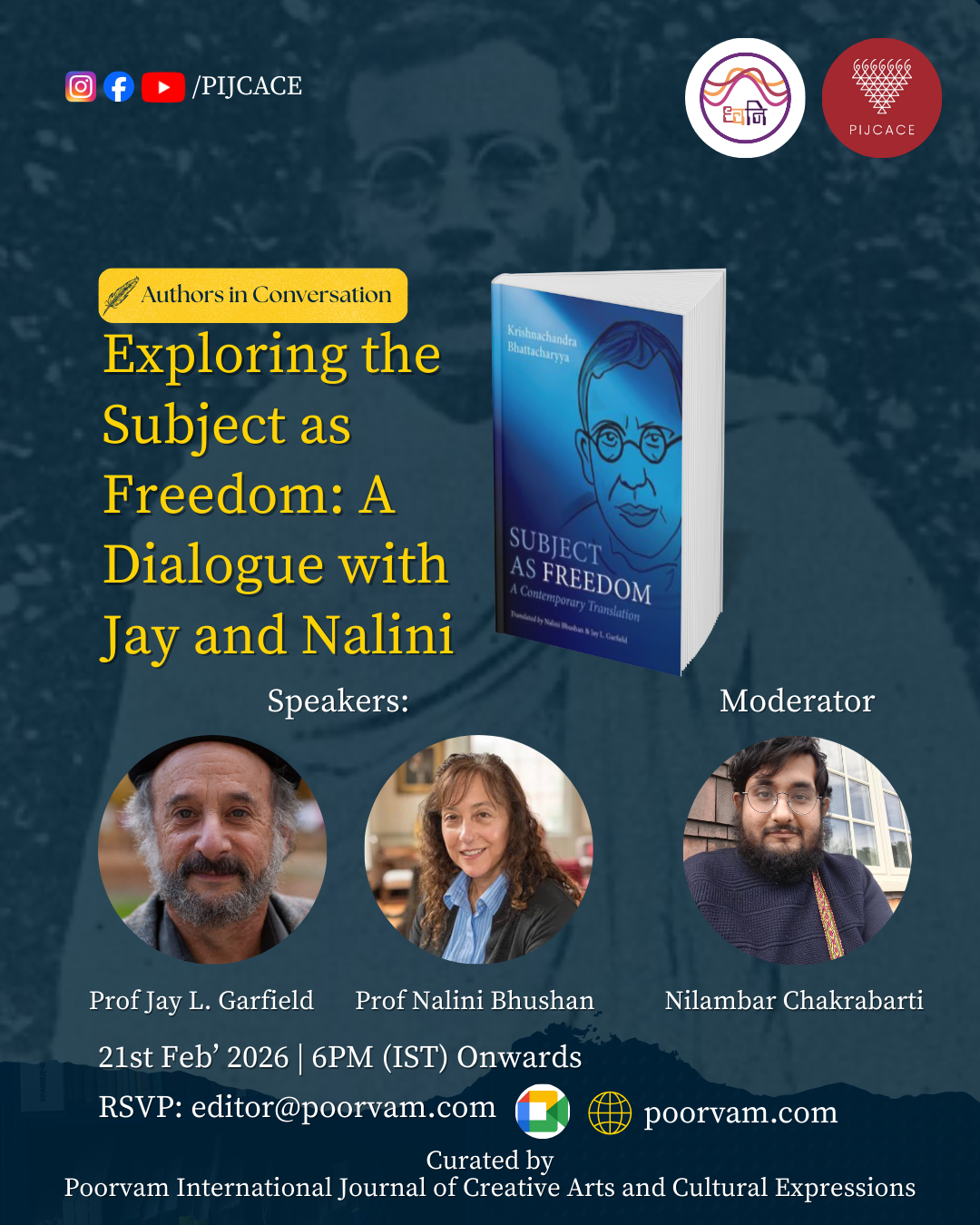
Prof. Jay L. Garfield FAHA is the Doris Silbert Professor in the Humanities and Professor …
Exploring the Subject as Freedom: A Dialogue wit…
Speaker
Prof. Nalini Bhushan is Andrew W. Mellon Professor Emerita in the Humanities and Professor…
Exploring the Subject as Freedom: A Dialogue wit…
Authors in Conversation
Cite It
Authors in Conversation
Call for Participation · Commemorative Volume
Poorvam International Journal invites scholars from across the philosophical world to contribute to a commemorative volume honouring one of the most influential philosophers of our time — the scholar who inaugurated our own Authors in Conversation series.
Abstract submission opens 1 July 2026
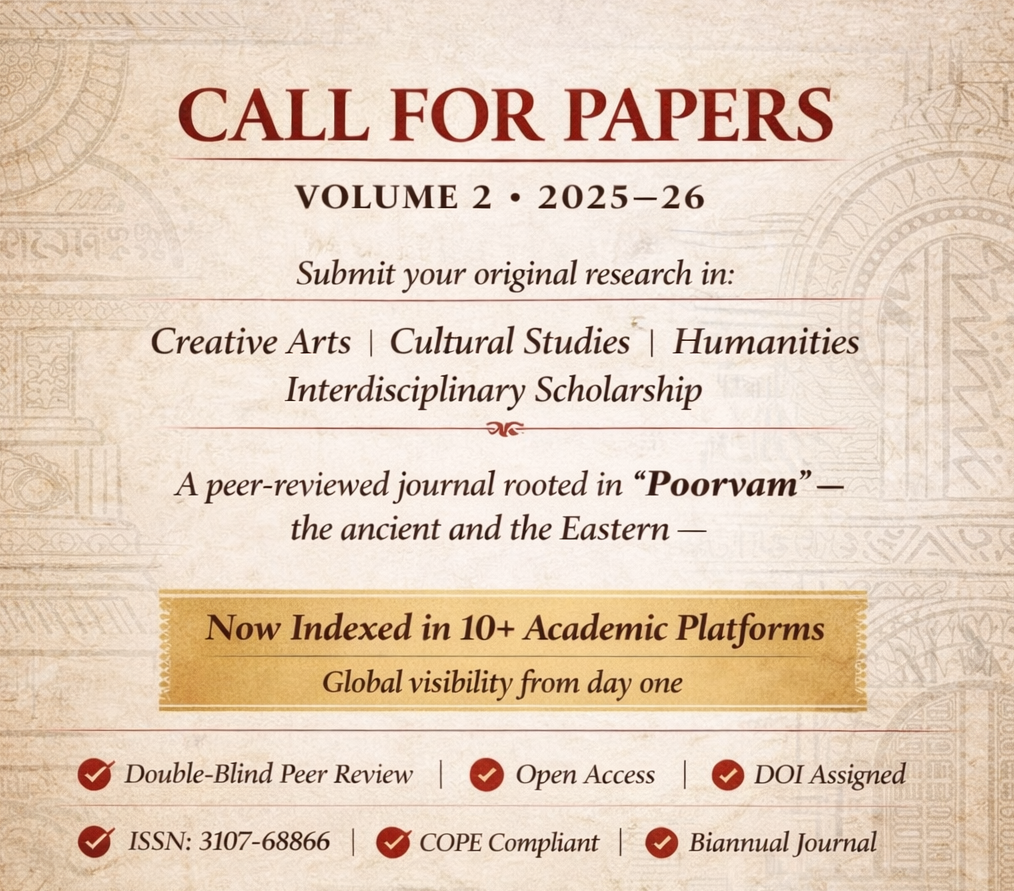
Poorvam International Journal is committed to maximum visibility and scholarly impact. Our content is discoverable through leading academic indexes and databases, ensuring global reach for researchers across every discipline.
DOI Registration & Global Registry
Published Content Integrity
Scholarly Literature Search
European Open Research Infrastructure
AI-Powered Research Discovery
Global Open Scholarly Metadata
Scientific Literature Database
Open Ukrainian Citation Index
Research Discovery by Editage
Publisher Verification
All indexing is independently verified. DOI prefix 10.63752/pijcace registered with Crossref.
Ecolinguistics, a relatively new sub-discipline of linguistics, is mainly based on the Sapir-Whorfian ideology of linguistic determinism which claims that the way we use language shapes our interactions with the environment. It is the study of “the life-sustaining relationships of humans with other humans, other organisms and the physical environment, with a normative orientation towards protecting the systems that humans and other forms of life depend on for their well-being and survival” (Alexander and Stibbe 105). The relations of humans with other species and the physical environment are of great importance, since the continuation of all life depends on these ecological relationships. T. S. Eliot’s The Waste Land (1922) is a frantic sincere expression of an agonized poetic soul to find out the means of getting rid of the mechanized stony cruelty-ridden modern life. The poem begins with a shocking sentential expression ‘April is the cruelest month breeding,’ but ends with the three-time asyndetic repetition of noun ‘shantih’ which a human being desires most. The present paper is a preliminary attempt to analyze and explore the poem from the perspective of ecolinguistics and to exhibit how poetic expression takes turns in depicting the integral relationship between all the constituents of environment affected by the ‘cruelest’ materialism and repaired by the peace-giving spiritualism.
Historically, Bengali literature has been acclaimed for its richness of fiction as well as poetry. However, not many Bengali authors have been found to be experimenting with the narrative forms. As far as themes and content of fiction were concerned the Bengali authors abundantly experimented; however, the same cannot be said in terms of the narrative style. For example, a widely accepted style like the magic realism was quite underexplored in the oeuvre of Bengali literature. Even when it is employed, as we can see in the works of Nabarun Bhattacharya, it seldom complicates the story-telling by bringing together historiography and magic realism. Rabisankar Bal precisely does that in his work, the Dozakhnama or Conversations in Hell (2010). Bal dexterously handles two different characters, namely Ghalib and Manto, belonging to two separate time periods, and retells the stories of immense historical significance. His narration provides a unique lens to look at the non-linearity of time and synthesizes discrete historical events of India that happened ninety years apart, namely in 1857 and 1947. This paper analyses some salient features of magic realism and shows how Rabisankar Bal appropriates them in his novel Dozakhnama, and in the process, creates a unique work that seldom finds any parallel in the literary realm of Bengali Literature.
This paper focuses on Niṣkāma karma or desireless action in the light of Śrīmadbhagavadgītā. Gītā, despite being a holy book, is an ethical handbook as well. So Niṣkāma karma or desireless action truly brings out the essence of the Gītā and revolves around the notion of desire and human agency in action. The paper first introduces what desireless action is and how it becomes a central question in the Śrīmadbhagavadgītā. The problem lies in the very core of the concept of desirelessness in action, which is surprisingly the slogan of Anāsakta karma or Niṣkāma karma. The paper gradually progresses towards bringing a solution to the apparent contradiction that follows if ‘desireless action’ is considered in the literal sense of the term. Why Niṣkāma karma becomes the point of question is due to the very word ‘niskama’, which seems to be in an apparent contradiction with the word ‘karma’ or action. It is either Niṣkāma karma is possible, or it is not. But following Gītā, Niṣkāma karma is possible and becomes an ethical dictum mostly throughout all the chapters. To support the idea that desireless action is possible, I will provide three accounts of non-literal senses of the term Niṣkāma karma and will try to provide which of these three accounts gives the most plausible explanation. All the interpretations mentioned require explanations separately, and at the conclusion, I will provide my stand towards which interpretation is the most plausible one.
This research paper analyses how recent Indian graphic novels re-envision the Ramayana, not only as mythology but also as an empowering graphic-textual means of grappling with contemporary issues that concern identity, power, gender, and ethics. Using a critical reading of Vikram Balagopal’s Simian (2014) and Samhita Arni & Moyna Chitrakar’s Sita’s Ramayana (2011), the research explores how the interplay of visual composition, page layout, artistic choices, and narrative voice in both problematizes and reimagines traditional notions of dharma, heroism, and divinity. This research paper also explores how these graphic novels, evaluated through a multidisciplinary framework of graphic narrative theory, comparative mythology, and cultural studies, subvert hegemonic portrayals of Rama and recentre marginalized voices like Sita. These visual reinterpretations are not just retellings; rather, they are also acts of cultural intervention, questioning who is allowed to interpret the epic and for what purpose. By moving the visual perspective and narrative voice, they present readers with a morally nuanced and aesthetically rich encounter, prompting questions about what it means to reinterpret sacred tradition in a rapidly changing world.
This paper explores the theme of female autonomy extensively with special reference to demanding female authority, rights, and freedom through the ‘occult’ form. The study involves a literary analysis of two popular Bollywood films Stree (2018) and Bulbbul (2020) and their larger-than-life portrayals of female autonomy in the occult form. Also, the paper tries to analyze how males become ‘the secondary sex’ in a patriarchal society while women are considered the dominant. This paper highlights females’ retreat over the male dominated society. Also, a subtle critique of the imposition of the mumpsimus ways of the society upon women, is presented in the paper. The binary between the male order and female subjugation has been completely overturned in these films. Though represented in occult forms, the female protagonists in these films symbolize every woman from every sphere and enforces the idea that men become recreants when facing any challenge or when restricted from enjoying freedom and power. Moreover, through feminist theories and readings, the study includes the theoretical analysis of women’s emancipation within the surroundings of Stree and Bulbul. Through the lens of feminism, the study provides an explorative area of how these films highlight the subverted gender dynamics. The paper also presents female empowerment challenging the long-standing patriarchal traditions and the societal expectations to accept the autonomy of women in occult practices.
Saradindu Bandyopadhyay’s immortal creation Byomkesh Bakshi stands apart from other conventional detective characters both in terms of benevolent understanding and humanitarian approach. His main objective is not merely to catch the culprit and bring him to justice, but to solve the crime and reach the crux of truth – famously identifying himself as ‘satyanweshi’ or the ‘truth seeker’. Whereas other detective characters complete their cases with a successful investigation of the crime, Byomkesh as an ‘inquisitor’ goes beyond the limited understanding of crime and punishment. His perception of truth is not confined within the finite scope of justice – either with the recovery of stolen goods or exposing the culprit; but the circumstances in which the crime has been committed. This paper is a modest attempt to critically analyse select stories of Byomkesh series, where the deductive reasoning of sleuth becomes secondary to the didactic teachings he imparts on the characters as well as readers. Byomkesh advocates exceptional methods and often takes unorthodox decisions which set him apart from the stereotype of Western detective models. His realisation of truth is as well the journey of readers from ignorance to experience. This paper also interrogates whether the ‘truth seeker’ aspect of his persona overshadows his capability as a criminal investigator.
A constellation of interconnected platforms, publications, and people — all united by a commitment to open, ethical, and world-class scholarly exchange.
A unified platform for open scholarly communication — connecting authors, reviewers, and readers across disciplines.
Our flagship peer-reviewed biannual journal publishing research and creative expression at the intersection of arts and culture.
The publishing imprint of Poorvam — bringing scholarly monographs, edited volumes, and creative works to global audiences.
Carcā (चर्चा) extends the Poorvam knowledge network - A living space for dialogue and learning
Your destination for literary excellence, cultural commentary, and profound reflections from India and the world.
An open-access, peer-reviewed, multidisciplinary biannual e-journal publishing original research and creative scholarship by students across Science, Arts, and Commerce.
Are you a researcher or creative artist? Submit your manuscript and join our vibrant community.
Submit Your Work